10 Most important trends in Cyber Security

Several key trends are shaping the future of the Netherlands’ cybersecurity industry. These trends underscore rapid technological advancements, evolving threat landscapes, and the growing need for robust regulatory compliance, positioning the country as a leader in digital defence innovation.
Person working with systems

1. Cybersecurity by Design and EU Regulatory Shift

The EU Cyber Resilience Act requires all digital products to be secure by design, secure by default, with lifecycle security obligations for manufacturers. The Netherlands is implementing NIS2 through the Cyberbeveiligingswet (expected Q2 2026), with approximately 8,000 organisations in scope.

The Nationale Technologie Strategie Cybersecurity prioritises secure‑by‑design, quantum-ready, and AI‑driven cyber resilience across sectors.
 

2. AI-Driven Threat Detection and Defence

Dutch organisations increasingly integrate AI/ML into cybersecurity, from real-time threat analysis to automated incident response. 

“AI has the potential to transform security processes, making them more scalable and proactive. At the same time, attackers are also exploring AI, so it’s a race to stay ahead.”

Arkadiusz Ostrycharz, Engineering Director, HackerOne
 

ABN Amro and TNO pilot self-healing software for autonomous recovery after intrusions. 


3. Cross-Sector Cyber Resilience Networks

Public-private initiatives demonstrate the Netherlands’ collaborative approach beyond single clusters. Some examples are the Cyber Resilience Network, FERM, and Brainport Cyber Resilience Centre. Resilience Network was launched in 2025 by NCSC NL and connects over 1,152 organisations. FERM is the national cybersecurity platform for Dutch seaports, including Rotterdam, Amsterdam, Moerdijk, North Sea Port, and Groningen Seaports, coordinating threat intelligence, knowledge sharing, and training across the maritime ecosystem.
 

4. Post-Quantum Cryptography Preparation

The Netherlands leads Europe in preparing for quantum-resilient encryption ahead of the projected Q-Day around 2030, through national programs such as Quantum-Secure Cryptography and the PQC Migration Handbook.

“The ecosystem we have in the Netherlands is very diverse, ranging from governance and law to high-tech clusters… for instance, post-quantum encryption or data diodes, but also sectors like banking, horticulture, and manufacturing.”

Mark Ruijsendaal, Program Director for Innovation, Security Delta (HSD)


5. Supply Chain Security & Third-Party Risk Management

Complex vendor networks amplify cybersecurity risks, making third-party risk management very necessary. Dutch organisations widely adopt frameworks such as CyFun, continuous security validation, and Software Bill of Materials (SBOMs) to improve supply chain visibility.

“Cybersecurity is something that no company or organisation can do by itself. You need connections with clients and with the network of stakeholders in cybersecurity. What is valued is: 1. to do the actual work, 2. be honest, and 3. show tenacity.”

Mark Ruijsendaal, Program Director for Innovation, Security Delta (HSD)
 

Managing these risks requires sustained collaboration across ecosystems. Public-private partnerships, sector-specific groups, and shared intelligence platforms such as TIBER-NL and NCSC-NL enable effective threat sharing and coordinated responses.


handshake
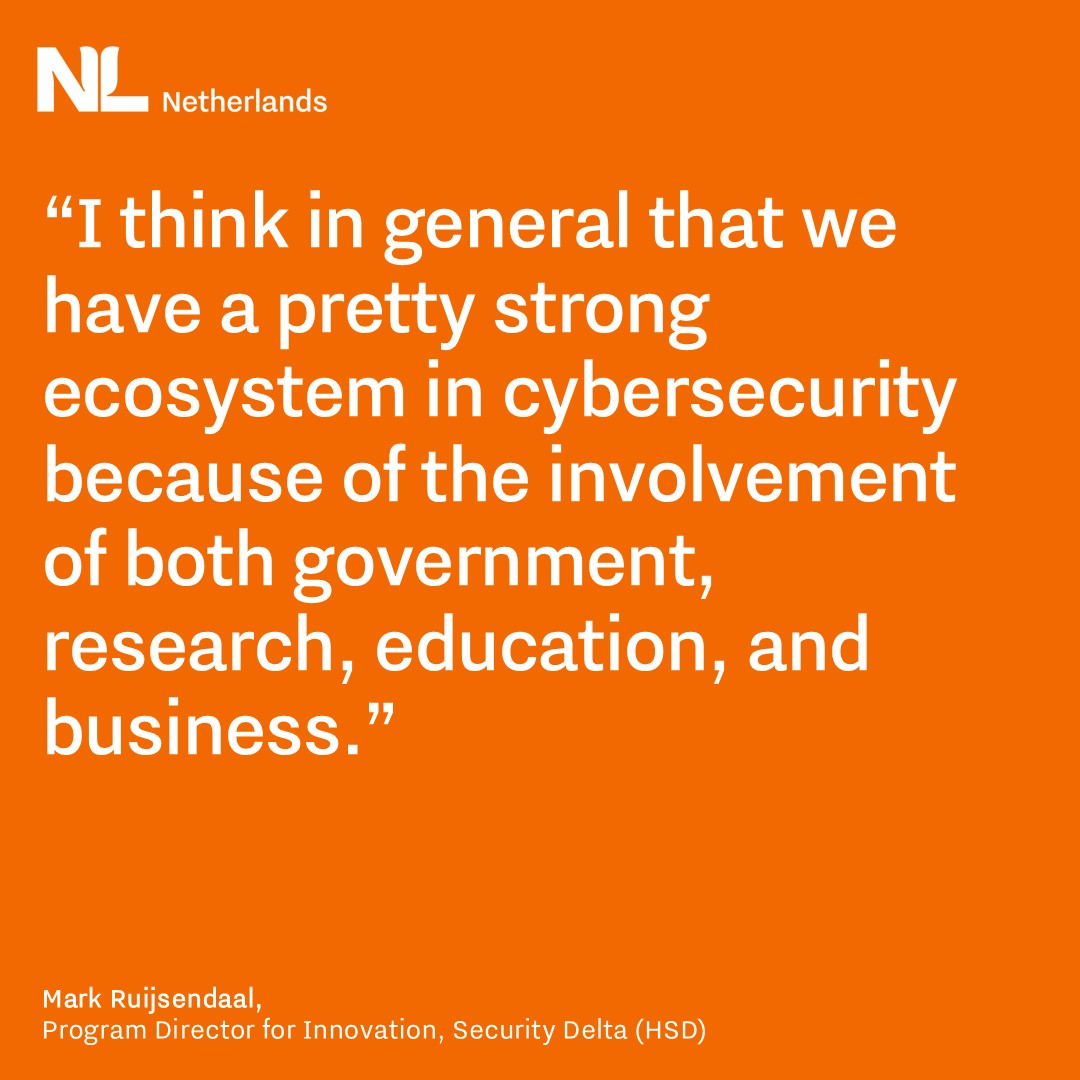
“I think in general that we have a pretty strong ecosystem in cybersecurity because of the involvement of both government, research, education, and business.”

6. Cloud Security & Multi-Cloud Challenges

92% SaaS adoption drives Netherlands cloud spending growth at 25.7% per year. Managing security across complex multi-cloud environments is a top challenge.

The Netherlands emphasises security-by-design, embedding protection from the start of development to ensure digital solutions are secure throughout their lifecycle and comply with Dutch and EU regulations. Systems configured as secure-by-default minimise vulnerabilities and attack surfaces out of the box. In addition, supply chain cybersecurity is a priority, with tools like Cybercheck helping organisations manage risks from suppliers and partners to safeguard national security and critical processes.
 

7. Cybersecurity Talent Shortage Crisis

The demand for cybersecurity talent is growing 60%, while 76% of EU security employees lack formal qualifications. Universities are unable to meet the demand, especially in Amsterdam and The Hague, resulting in wage pressure, project delays, and increased reliance on managed services.

“CVD structurally connects education, business, and the government, helping reduce the shortage of cybersecurity professionals. Students and professionals are trained through customised education programs designed with direct input from practice, enabling them to be effective immediately or to upskill while on the job.” 

Mark Dorenbusch, Director, CVD
 

According to ENISA surveys, 89% of Dutch firms plan to hire additional security staff before 2026 to meet NIS2 requirements, yet competition for qualified candidates is fierce. In response to this persistent shortfall, the Ministry of Defence is recruiting cyber reservists, while both the government and the private sector are investing in new upskilling programs, academic partnerships, and university centres of excellence.

“We don’t mind setting up centres of excellence in universities so that computer networks or telecom engineering students are future-ready and clearly know where to contribute when they graduate.”

Shivaprasad Mynahalli, Founder & Director, TelcoSolve

Strategic funding now supports comprehensive talent development, ensuring a diverse, future-ready workforce.
 

8. NIS2 & DORA Regulatory Compliance

EU regulatory mandates drive significant transformation in Dutch practices, with NIS2 enforcement set to commence in Q2 2026, covering 18 critical sectors. DORA introduces comprehensive resilience testing requirements.
 

9. Critical Infrastructure Protection

State-sponsored threat actors and hacktivist organisations pose increasing threats to critical infrastructure, especially targeting energy, transportation, and telecommunications systems. Russian state actors and 18 APT groups actively target industrial control systems.


10. Enhanced Identity & Access Management

Credential-based attacks dominate breaches, with account takeovers accounting for 38% of successful intrusions. Emerging trends include passwordless authentication and adaptive multi-factor systems.

These trends highlight how the Netherlands is shaping the next era of cybersecurity through innovation, collaboration, and resilience. By embracing AI, preparing for quantum risks, and investing in talent and regulatory readiness, the country strengthens its position as a global leader in digital security. This forward-looking approach safeguards national infrastructure and creates new opportunities for experts, businesses, and investors to help build a safer, more trusted digital future.


Next steps

The Netherlands has transformed from a digitally connected nation into Europe’s thought leader through strategic collaboration, prioritising shared insights over competitive secrecy and collective resilience over individual defence mechanisms. This transformation demonstrates that leadership emerges not only from technological superiority but from philosophical innovation that reimagines how societies protect themselves in the digital age.

The Dutch model, combining world-class educational institutions, strategic investment, innovative private sector solutions, and unprecedented public-private partnerships, provides a comprehensive blueprint for national excellence. Through pioneering companies like EclecticIQ and Zivver, the Netherlands exports more than solutions. It promotes a transformative philosophy treating digital security as a foundation for human flourishing.

Now is your chance to join this movement as an entrepreneur, innovator, or cybersecurity professional and help build a secure, resilient, and thriving digital future in the Netherlands and across Europe.


More on Cyber Security in NL

To dive deeper, explore our articles on cyber security in the Netherlands and working in the industry. Finally explore the different regions in the Netherlands that have a strong cyber security presence such as the Hague and Amsterdam.